



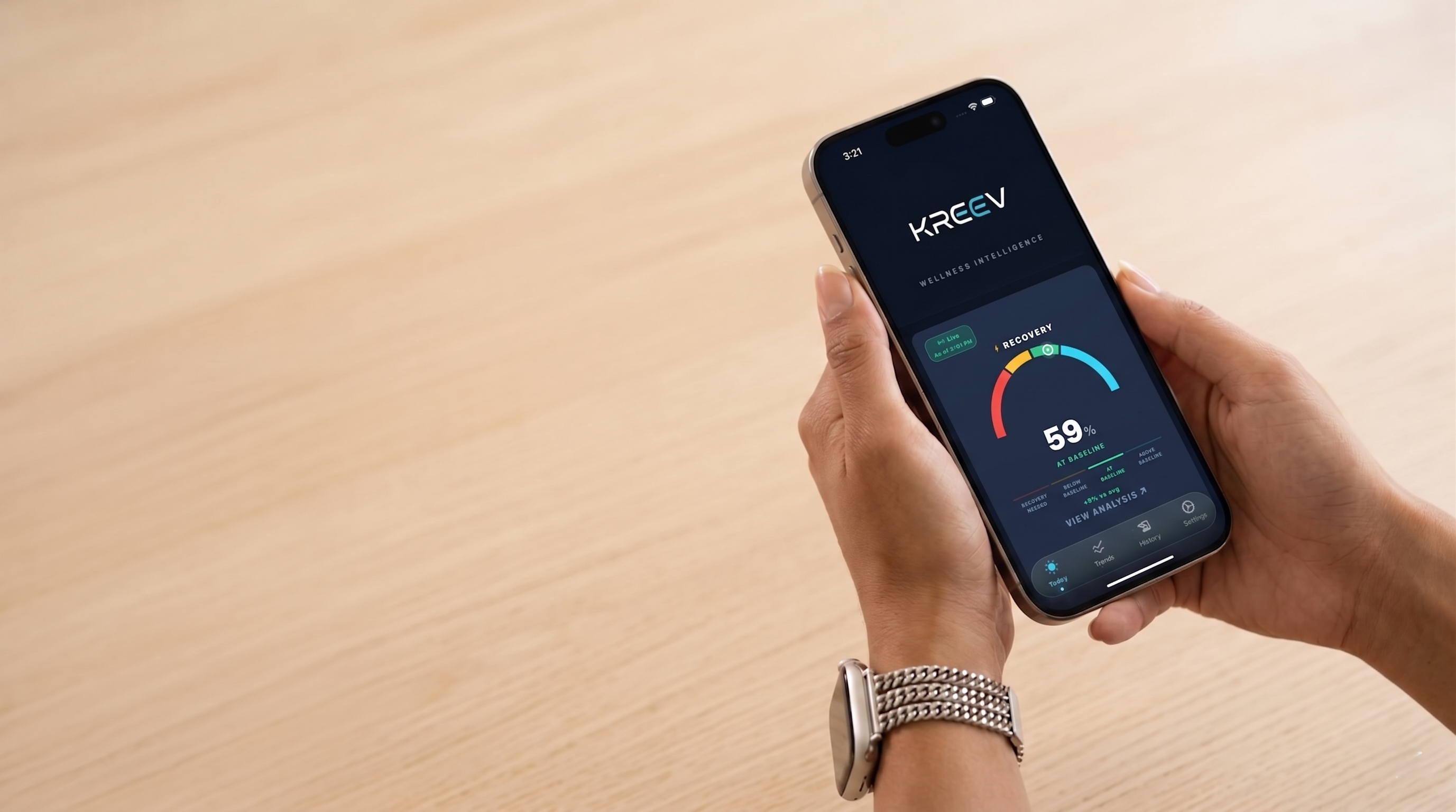

Your Apple Watch already records the signals that show how well you're ageing. Kreev turns them into a free Healthspan Index, a daily Recovery Score and a VO₂ Max trend — all measured against your own baseline, not a population average. Nothing extra to buy or wear, and your health data never leaves your iPhone.
iPhone · iOS 16+ · Apple Watch Series 4+
Join the waitlist
Your name and email are stored by Brevo, our email provider, and used only for the messages you sign up for. Unsubscribe anytime. See our Privacy Policy.
Coming soon.
Kreev reads what your Apple Watch already records and turns it into a small number of measurements you can act on. It is not a training app, and you do not have to be an athlete to use it: the things it watches — heart-rate variability, resting heart rate, sleep, VO2 Max — are the same markers that track how well a body is ageing, whether you are chasing a personal best or simply intending to still be doing this in twenty years.
Two of those matter more than the rest. HRV is the clearest daily read on whether your nervous system is coping with the load you are putting on it. Cardiorespiratory fitness — VO2 Max — is strongly associated with living longer, and unlike most things on a lab report, you can move it.
Kreev measures both against you, not against a population. And because slow change is the kind nobody notices, the Boiling Frog detector compares your recent months to your earlier ones and tells you when something has drifted — a VO2 Max that has slipped three points since spring, a bedtime that has crept later every week. That is the decline that does damage, and it is invisible day to day.
Newest: your Healthspan Index — five ageing markers scored into one number out of 100, free — and Kreev on your Apple Watch, where today's numbers sit on your watch face and are already current before you pick up your phone.
Five measurements that track how well you are ageing — VO2 Max, HRV, resting heart rate, sleep, and sleep regularity — each scored out of 20, for one number out of 100. Nothing is weighted by your age or compared to anyone else: every component is scored on your own data. The ring shows which of the five is carrying you and which is holding you back, and the whole breakdown is free.
The Index and its breakdown are free. The six-month trend is Sentinel.
Free The Index and its breakdown
Sentinel The six-month trend
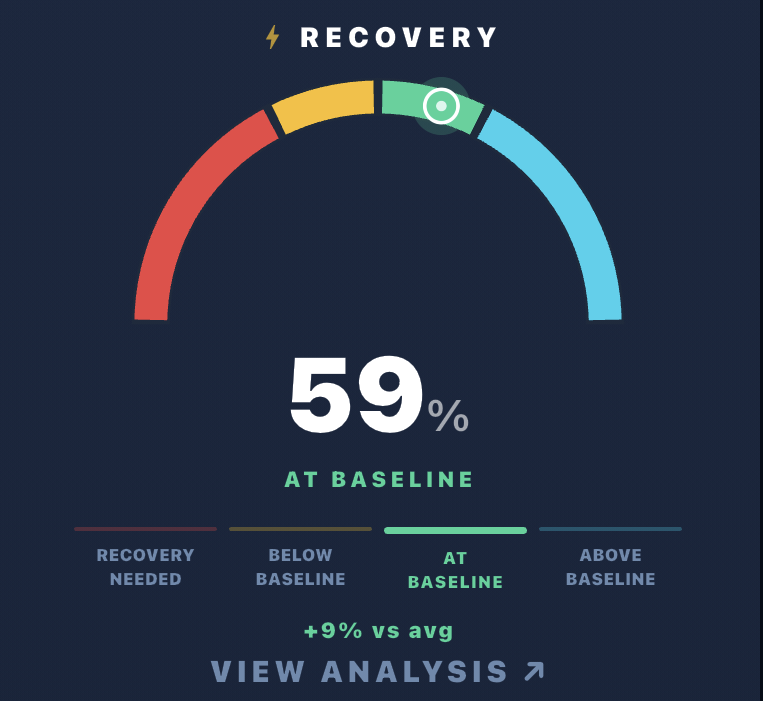
On Kreev's scale, 50 means your usual — not "half recovered." The scale is centred on your own 30-day baseline, about 15 points for each standard deviation of your own variation, so an ordinary morning lands near 50 and an 80 is genuinely exceptional. A score moves only when your body does.
Free A real morning: 52, right at baseline
Free the number · Sentinel the ranking
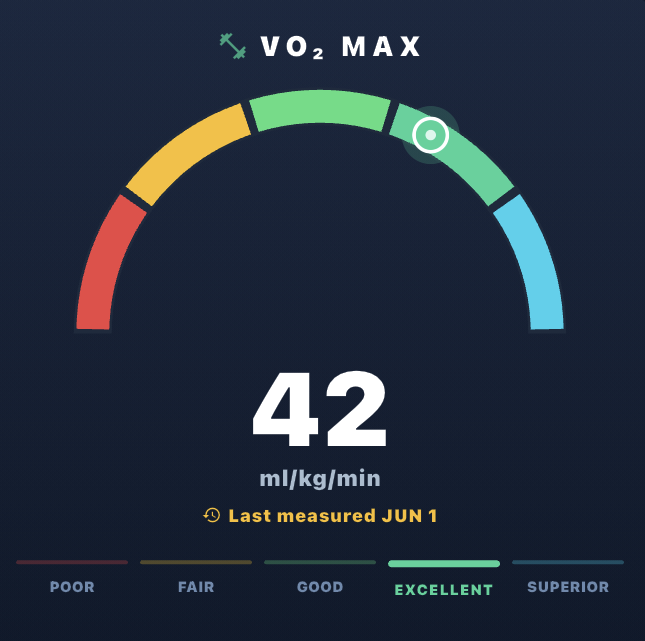
Kreev calculates VO₂ Max itself from your heart-rate data, using the published Heart Rate Ratio method (Uth, Sørensen, Overgaard & Pedersen, European Journal of Applied Physiology, 2004), Once one of your workouts includes a hard, sustained effort, it uses the highest heart rate you've recorded within the last 12 months, so the estimate follows you as you age. Until then it uses a formula based on your age and sex. The app labels each estimate “Personalized” or “Formula-based”. It is an estimate — a trend to watch, not a lab test.
Why it matters: cardiorespiratory fitness is strongly associated with lower all-cause mortality (Kodama et al., JAMA, 2009; Mandsager et al., JAMA Network Open, 2018).
Your VO₂ Max number is free. Where it ranks against ACSM norms for your age and sex — and how far you are from the next band — is Sentinel.
Day to day, a slow drift looks like nothing: every reading is within your normal variation. Kreev compares your last 30 days with a 60-day reference window that ends where those 30 begin, and tells you when a metric has moved away from where it used to sit — a resting heart rate that has crept up, a VO₂ Max that has slipped.
It needs about 45 days of data inside the reference window. Because Kreev imports your last 30 days from Apple Health when you install, someone who already wears their watch typically sees it after roughly six weeks of use.
Kreev finds what shapes your recovery from data your watch already collects. There is nothing to log.
One heatmap per month for your last six months, each day coloured by its Recovery Score. Runs of amber or red days show accumulated load that a monthly average hides; a weekday that is always low shows up as a column.
What the app has learned from your own history, in plain sentences. It looks at:
Free shows your most frequent bottleneck and your strongest pattern. Sentinel adds the Archive, the weekday read and every pattern with its numbers.
Patterns need about 60 days of history — with the 30-day import, roughly a month of use — and the Archive fills in month by month. These are patterns in your measured data (sleep, strain, steps, breathing rate, heart rate, weekday), not causes.
Your Healthspan Index, Recovery Score, Strain and VO₂ Max are free — no extra hardware. Sentinel adds the direction of travel and the full interpretation layer, plus the Kreev Apple Watch app, for $5.99/month or $39.99/year (~44% off). New subscribers get 1 month of Sentinel free through the App Store; unless you cancel before it ends, it converts to the plan you chose. Cancel anytime in iPhone Settings → Apple ID → Subscriptions.
| The question | Free | Sentinel |
|---|---|---|
| How is my body today? | Recovery Score, Strain, overnight metrics, Healthspan Index with its five-component breakdown, VO₂ Max value | Everything in Free |
| Where do I stand against people my age? | — | VO₂ Max ACSM ranking — category, percentile band, distance to the next band |
| Is it getting better or worse? | 7-day trends and the current month | Six-month Healthspan trend, extended history, Boiling Frog detector |
| What shapes my good and bad days? | A preview: your most frequent recovery bottleneck and your strongest pattern | Autonomic Archive (six monthly heatmaps), the weekday read, every pattern with its numbers |
| Why, in plain English? | — | Daily narrative, Weekly Debrief, Month in Review, the “Why” behind each score |
| How should I train this week? | Strain | Recovery vs Strain, This Week suggested hard days, detailed drill-downs, Guardian Alerts |
| At a glance on my wrist? | The Kreev brand-mark complication | Watch app + Recovery, Strain, VO₂ Max and Healthspan complications |
Kreev's free tier is the iPhone app. The Kreev watch app and its Recovery, Strain, VO2 Max and Healthspan complications are part of Sentinel — you can still add one to a watch face for free, but it will show a lock instead of a reading.
Introductory offers are administered by Apple and available once per Apple ID. Your subscription follows your Apple ID, not your phone — use Settings → Restore Purchases on a new device. We remind you before each renewal. Nothing is deleted when a subscription ends: your history stays on your iPhone and the free tier keeps working.
Join the waitlistEvery morning, Kreev analyses your overnight biometrics — heart rate variability, resting heart rate, sleep quality, activity load, respiratory rate — and distills them into a single Recovery Score from 0 to 100. Not a guess. Not a population average. A precise reading of how your body recovered, compared to your own history.
vs your personal baseline
Recovery Compass
Most wellness apps compare you to population averages — norms built from studies that may not reflect your age, fitness level, or physiology. Kreev is different. It builds a rolling baseline from your own recent history and measures how today deviates from your normal. An elite athlete with a resting heart rate of 42 bpm and a weekend jogger at 72 bpm both get scores that reflect their individual recovery — because the reference point is always you.
Your Apple Watch collects heart rate, HRV, sleep, steps, respiratory rate, and VO2 Max throughout the day and night.
Kreev builds a rolling average of your last 30 days. This is your personal normal — unique to your body.
Each morning, today's metrics are compared to your baseline using Z-score statistics. The result is your Recovery Score.
Every metric has a story. Kreev reads them all.
See it in the app
Your recovery score of 64 indicates you are tracking at your personal baseline today. HRV at 54 ms sits 7% below your 30-day average of 58 ms, pointing to mild residual autonomic load — likely from recent training sessions. Resting heart rate at 56 bpm is marginally elevated from your typical 54 bpm, consistent with moderate, unresolved physiological demand. Sleep duration of 7.1 hours and deep sleep at 18% of total time are in line with your recent norms. Yesterday's moderate activity load leaves no significant cumulative strain. You are recovered to your typical level — a standard training day is appropriate.
Every morning, Kreev writes a narrative that explains exactly why your Recovery Score is what it is: which metrics moved, how far from your baseline, and what pattern that fits. It is produced by a rules-based engine that runs on your phone — no AI service, no upload, the same inputs always produce the same explanation. No medical jargon. No vague advice. Just your data, interpreted.
Generated entirely on your iPhone — nothing is transmitted
Works offline and in airplane mode
The methodology is published in our Terms of Service
Sentinel A real morning's narrative
Everything above still applies. If you also train, Kreev adds load to the picture. The guide goes deeper →
A daily measure of the physiological demand you've put on your body, from your actual heart rate, shown against your own baseline.
A side-by-side chart of how your recovery and your load interact over time.
Suggests days for harder sessions from your recovery history, and where the easy days fall. It is not a prescription.
Post-session heart-rate recovery, measured against your own history rather than a population table.
Part of Sentinel.
Kreev's watch app shows the same four numbers as your phone — Recovery, Strain, VO2 Max and your Healthspan Index — plus today's training context. Add a Kreev complication to any watch face and it is there at a glance, updated in the background before you pick up your phone.
Your iPhone does all the computing and sends only the finished scores to your watch, directly, over Apple's own encrypted connection. Kreev's watch app has no access to Apple Health at all — there is nothing on your wrist to leak, and nothing goes over the internet to get there.
Recovery with your HRV and Resting HR movement, Strain, VO2 Max with its ACSM ranking, and your Healthspan Index — one scrolling screen, no menus.
Recovery, Strain, VO2 Max, Healthspan, and a Kreev brand mark for faces with only one slot. Most faces hold one to four, so mix and match.
Kreev refreshes in the background as Apple Health delivers new readings — so the morning number on your wrist is already today's, before you open anything.
See it on your wrist
Kreev publishes its scoring methodology, names every company that touches your data, and lets you export or erase everything yourself. Because it runs on your iPhone, nobody receives your health data.
Your Recovery Score uses Z-score statistics against your personal rolling baseline. We explain the methodology in our Terms of Service — no black boxes.
Your score doesn't factor in age, sex, or ethnicity. Every user is compared to their own history — not a population average.
We don't use advertising cookies. We don't sell your data. We don't share it with data brokers. Ever.
CCPA/CPRA and MHMDA rights, PIPEDA compliance, and a published methodology. There is no account to delete — Settings → Reset This Device erases everything, and deleting the app does too. Export My Data gives you a full copy; Import My Data brings it back.
Read our Privacy Policy, Terms of Service, and Consumer Health Data Privacy Policy.
Join the waitlist for launch news. Free to start, no extra hardware, and your data never leaves your iPhone.
Requires iPhone (iOS 16+) and Apple Watch Series 4+ · 18+
Your name and email are stored by Brevo, our email provider, and used only for the messages you sign up for. Unsubscribe anytime. See our Privacy Policy.